Sail Plan


Sheet loads and Travel in a Force 4
| Sail 1:10 | Area cm.sq | Sail Loads Kg (1) | C of E A | Clew B | M.A. | (3)Sheet Load Kg | Travel cm |
|---|---|---|---|---|---|---|---|
| Main - Full | 10560 | 5.3 | 52 | 100 (2) | 1.9 | 2.8 | 90 |
| Main - 1 Reef | 8280 | 4.1 | 50 | 100 (2) | 2.0 | 2.1 | 90 |
| Main - 2 Reefs | 6040 | 3.0 | 46 | 100 (2) | 2.2 | 1.4 | 90 |
| Topsail | 2680 | 1.3 | 22 | 50 | 2.4 | 0.5 | |
| Jib | 3080 | 1.5 | 14 | 42 | 3.0 | 0.5 | 90 |
| Staysail | 2452 | 1.2 | 12 | 50 | 4.2 | 0.3 | 75 |
| Yankee | 2480 | 1.2 | 18 | 40 | 2.2 | 0.5 | 60 |
+ = Position of Centre of Effort.
A = Distance of C of E from luff or mast centre.
B = Distance of Clew E from luff or mast centre.
M.A. = Mechanical Advantage = B/A
Sheet load = Sail Force / M.A. Double for force 5 and halve for force 3.
Travel = length of sheet to pull the sail from full out to full in.
(1) - Sail Load in Kg calculated for a Force 4 wind using 0.5g/cm.sq using info from 1/20 model.
(2) - Distance of main sheet E from mast centre.
(3) - Using a factor of safety of 2.
Sail Forces/Moments in a Force 4
| Sail 1:10 | Area cm.sq | Sail Loads | Vertical C of E | Vertical Moments | Horizontal C of E | Horizontal Moments |
|---|---|---|---|---|---|---|
| Main - Full | 10560 | 5.3 | 87 | 460 | 53 | +280 |
| Main - 1 Reef | 8280 | 4.1 | 80 | 330 | 49 | +200 |
| Main - 2 Reefs | 6040 | 3.0 | 70 | 210 | 48 | +144 |
| Topsail | 2680 | 1.3 | 168 | 220 | 24 | +31 |
| Jib | 3080 | 1.5 | 62 | 90 | 58 | -90 |
| Staysail | 2452 | 1.2 | 61 | 70 | 25 | -30 |
| Yankee | 2480 | 1.2 | 140 | 170 | 31 | -37 |
+ = Position of Centre of Effort.
Vertical C of E cm = distance of the C of E from the waterline.
Horizontal C of E cm = distance of the C of E from the mast.
Vertical Moments Kgcm = Heeling moments.
Horizontal Moments Kgcm = Yawing moments. + are clockwise and - are anti-clockwise.
Main Sheet Travel
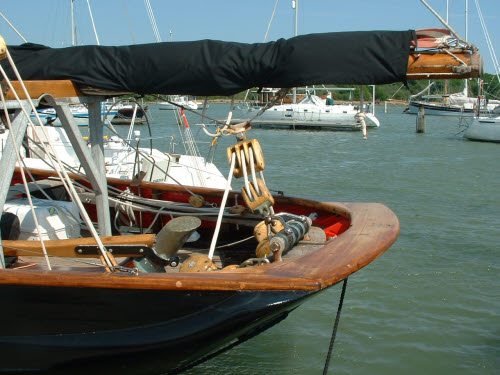
The main sheet arrangement is unusual in that it has seven effective pulleys. The boom has a triple pulley block with a double block attached to the centre of the rear rail and two single blocks two each side. The main sheets are lead forwards and cleated just forward of the seat.
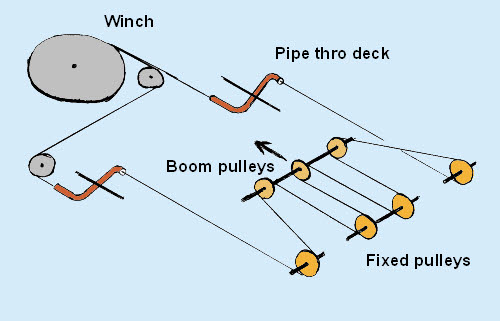
The main sheet pulleys give a 1:7 mechanical advantage so the sheet load is 1.32 x 1/7 = 0.2kg. (excludes any allowance for friction or factor of safety). The sheet travel is 90 x 7 = 6.3m.
As their are two main sheets, the individual sheet load is 0.2 / 2 = 0.1kg and the travel 3.15m
On the model the main sheets are feed through two copper tubes hidden in the seat supports down to the winching arrangements.
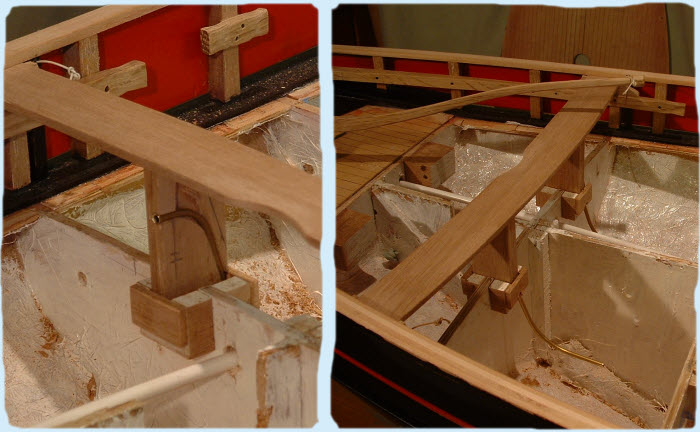
The maximum drum size that will fit in the hull is 10cm horizontally which has a circumference of 31cm which will need 10.2 rotations to wind in the 3.15m sheet. If a "servo stertcher" is added to the Hitec sail servo we can get seven rotations. A gearing system of 70:100 will reduce the 10.2 rotations down to 7 needed for the winch.
If both sheets are feed by one drum it would require a torque of 10/2 x 0.2 = 1kg.cm. As the Hitec winch can supply 13 times this torque the drum size can be reduced.
If the drum diameter was 5cm giving a circumference of 15.7cm needing 315/15.7 = 20 rotations. Requiring a torque of 0.2 x 2.5 = 0.5kg.cm.
A gear ratio = 20:7 will be need to reduce to 7 turns so increasing the torque to 0.5 x 20/7 = 1.5kg.cm. Add a factor of safety of 2 = 3kg.cm. A Wind Force 5 would require to double the torque to 6kg.cm which is well inside the Hitec's ability.
Main Sheet Self Winding Drum
Now for the difficult part. Pulling in the main sheet is no problem. If you let out the main sheet when there is no pull from the boom, the sheet will not be drawn up through the deck pipe and will spool off the drum into the hull, all 3.1m. Some form of self winding mechanism will have to be put between the drum and the sheet deck pipe.